
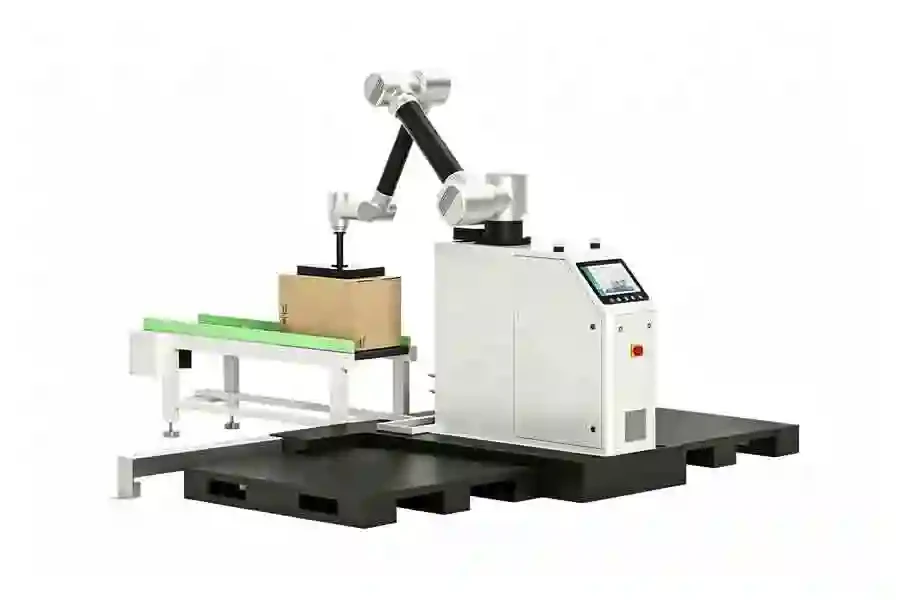
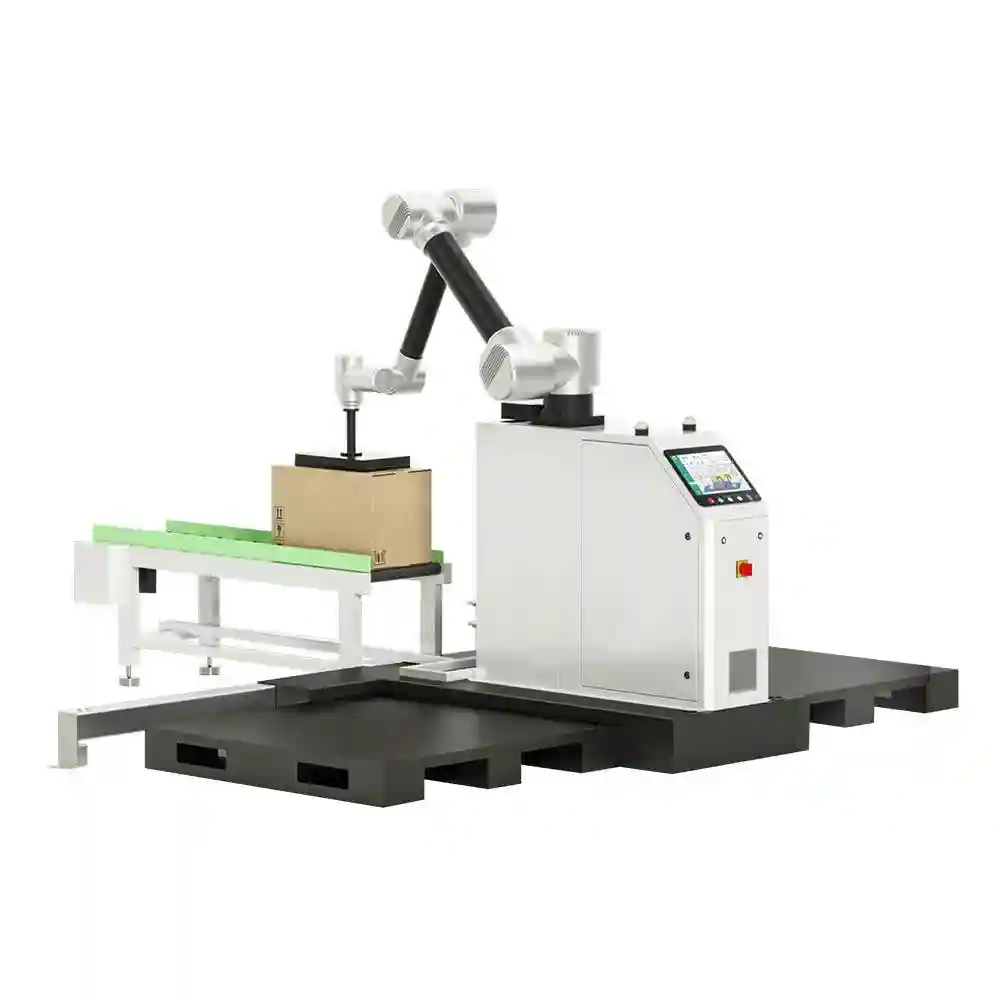
industrial collaborative robot palletizer is an automated device widely utilized in the fields of industrial manufacturing and logistics. Its core function is to automatically and neatly stack packaged goods—such as cartons, bags, bottles, and cans—onto pallets, adhering to specific arrangement patterns and layer requirements. This facilitates subsequent handling via forklifts, warehouse stacking, or centralized shipping. Widely adopted across industries including food, pharmaceuticals, 3C electronics, daily chemical products, and e-commerce, the device operates with exceptional safety and stability. It features built-in anti-collision capabilities and ensures that safety protection mechanisms remain fully operational even in the event of a single-point failure. Programming is straightforward, utilizing a visual interface that makes operation simple and highly efficient; users can easily get started without requiring specialized knowledge of programming languages. Furthermore, the system offers flexible deployment options and features a compact footprint. Parameter configuration is simple, intuitive, and easy to master. Upon delivery to a factory, the equipment can be fully installed and commissioned within just two hours; setting up a new operational path takes only five minutes, enabling the simultaneous palletizing of two different types of products at speeds ranging from 8 to 14 cartons per minute. The system supports the configuration of up to 1,000 distinct palletizing paths and accommodates pallets with maximum dimensions of 1400 × 1400 mm.


Main Features
1. Effortless Operation for All Users
The collaborative robot palletizer boasts an intuitive visual programming interface, making it easy for operators to use. No prior programming knowledge is required, enabling even those without technical expertise to quickly master its operation. The programming process is streamlined, with basic functions typically learnable in just 30 minutes. This ease of use helps reduce training time and associated labor costs, ensuring quick setup and minimal downtime.
2. Adaptable and Space-Efficient Design
Designed with flexibility in mind, the collaborative robot palletizer has a compact, integrated structure that makes it ideal for spaces with limited floor area. Whether you’re setting up new workstations or adjusting tasks, the system can be quickly redeployed or reprogrammed to meet evolving production requirements. This adaptability allows manufacturers to stay agile in a fast-paced production environment and improve overall workflow efficiency.
3. Versatile Across Various Industries
The collaborative robot palletizer is a versatile solution used in a wide range of industries, including food processing, pharmaceuticals, electronics (3C), chemicals, and e-commerce logistics. Its ability to handle different types of products and palletizing configurations makes it a valuable asset in diverse automated production lines, driving operational efficiency and consistency.
Technical Parameters
| Model | NP-MD30 |
| Load Capacity | 20kg [Maximum load 30kg (including end effector + case weight)] |
| Working Radius | 1800mm |
| Lift Height (Vertical) | H2=2400mm (Including pallet height) |
| Palletizing Speed | ≤ 8 pcs/min |
| Repeat Positioning Accuracy | ±0.04mm |
| Communication Method | TCP/IP |
| IP Rating | IP54 |
| Temperature Range | 0-55℃ |
| Maximum Power Consumption | 3.3kw |
| Power Supply Requirement | Single-phase 220V/50HZ |
| Overall Weight | 500kg |
| Footprint | 1400*1610mm |
How Do Collaborative Robot Palletizer Systems Work, Including the Process from Product Infeed to Pallet Outfeed?
collaborative robot palletizer play a pivotal role in streamlining packaging processes and boosting overall supply chain efficiency. By automating the stacking and arranging of products onto pallets, these systems minimize manual handling, significantly reducing the risk of injury and labor costs.
Modern palletizing robots offer a range of payload capacities—from handling lightweight items to managing heavy bulk goods—making them versatile for various industries and applications. With advanced control interfaces and pattern-setting software, operators can quickly adjust configurations for new products or packing patterns, often setting up new palletizing paths within minutes.
How Collaborative Robot Palletizer Works?
Typically, products enter the robotic cell via an infeed conveyor system, arriving in a steady flow ready for palletizing. A pallet is positioned in the loading area, either automatically dispensed or placed by the robot itself. The robotic arm then picks up one or more products at a time—depending on the application—and precisely places them onto the pallet.
Layer by layer, the robot builds the pallet load, incorporating slip or tier sheets as needed for added stability. Once the pattern is complete, the finished pallet is removed from the cell via an outfeed conveyor, where it can proceed to stretch wrapping or other downstream processes. The robot then seamlessly begins the cycle again with a fresh pallet, ensuring continuous, efficient operation.
What Are the Main Applications of Collaborative Robot Palletizer, Such as Case Palletizing, Row Palletizing, Full Layer Palletizing, Cobot Palletizing, and Bag Palletizing?
Robotic palletizers are commonly used in industries like food, pharmaceuticals, 3C electronics, daily chemicals, and e-commerce. They offer safe and stable operation with anti-collision functionality, ensuring safety remains intact even if a fault occurs. Their visual programming interface makes them simple and efficient to use, with no need for programming expertise. Additionally, their compact design allows for flexible deployment in various production environments.
Versatile Applications
How do collaborative palletizing robots adapt to different palletizing needs?
Case Palletizing
They efficiently load individual product cases onto pallets one by one, offering better speed and flexibility than manual handling.
Row Palletizing
Can pick and place entire rows of homogeneous products in one motion, enhancing throughput and operational efficiency.
Full Layer Palletizing
These robots can handle complete layers of cases at once, using standardized end-of-arm tooling, increasing productivity and reducing cycle times.
Cobot Palletizing
Specifically designed to operate safely in spaces with frequent human interaction, requiring less floor space and investment compared to traditional industrial robots.
Bag Palletizing
They integrate with checkweighers, bag flatteners, labelers, or squaring devices before palletizing, ensuring precise order fulfillment and stable pallet loads.
Custom Palletizing Solutions
Can be tailored for use in demanding environments such as cold storage or for handling heavy, awkward, or hazardous materials like scrap metal and batteries.
What makes the collaborative palletizing robot a reliable choice for manufacturers?
Its adaptability allows manufacturers to achieve efficient, safe, and scalable automation in a wide variety of production environments.